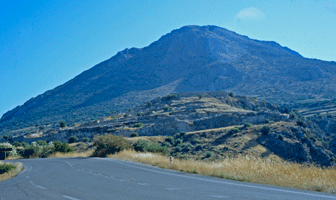
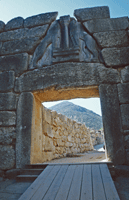
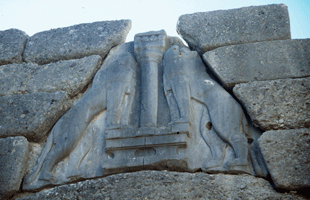
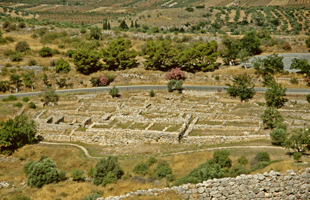
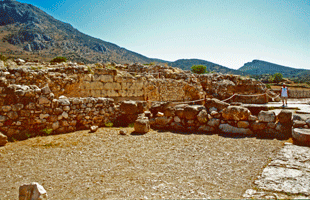
Mycenae is an archaeological site near Mykines in Argolis, north-eastern Peloponnese, Greece. It is located about 120 kilometres (75 miles) south-west of Athens; 11 kilometres (7 miles) north of Argos; and 48 kilometres (30 miles) south of Corinth. The site is 19 kilometres (12 miles) inland from the Saronic Gulf and built upon a hill rising 274 metres (899 feet) above sea level.
In the second millennium BC, Mycenae was one of the major centres of Greek civilization—a military stronghold which dominated much of southern Greece, Crete, the Cyclades and parts of southwest Anatolia. The period of Greek history from about 1600 BC to about 1100 BC is called Mycenaean in reference to Mycenae. At its peak in 1350 BC, the citadel and lower town had a population of 30,000 and an area of 32 hectares (79 acres).
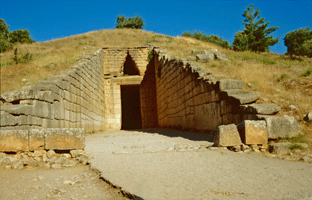
Near Mycenae is the Tomb of Clytemnestra a Mycenaean tholos type tomb built in c. 1250 BC. A number of architectural features such as the semi-column were largelyadopted by later classical monuments of the first millennium BC, both in the Greek and Latin world. The Tomb of Clytemnestra with its imposing façade is together with the Treasury of Atreus the most monumental tomb of that type.
The entrance to the tomb consists of a dromos with walls of ashlar in conglomerate. Similarly, the stomion is built from the same element. The exterior façade of the stomion is decorated with half-columns made of gypsum which were carefully carved with ornate capitals and vertical fluting. A large relieving triangle overlaps the door lintel. It was originally decorated by a colored relief sculpture.[4] Through the lintel block a small drain is cut in the rock, lined with low rubble walls and roofed with small slabs. Above them two stones are set to take the direct pressure off the covering slabs.
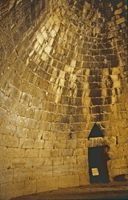
The surface of the tomb was covered with coat of white plaster. The burial chamber has a diameter of 13.4 metres (44 ft.). Most blocks are sawn rather than hammer-dressed. The tomb chamber is constructed throughout of ashlar conglomerate masonry.
We visited here in June 2004.
HOVER over image for title. Click here to return to Greece Main Page.