The Palace of Nestor was an important centre in Mycenaean times, and described in Homer's Odyssey and Iliad as Nestor's kingdom of "sandy Pylos"
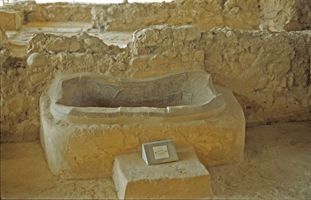
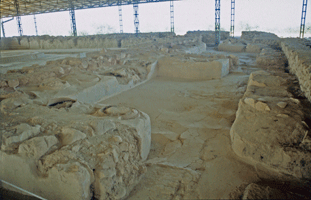
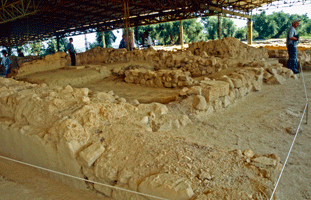
The site is the best preserved Mycenaean Greek palace discovered. The palace is the primary structure within a larger Late Helladic era settlement, once probably surrounded by a fortified wall. The palace was a two-storey building with store rooms, workshops, baths, light wells, reception rooms and a sewage system.
The settlement had been long occupied with most artifacts discovered dating from 1300 BC. The palace complex was destroyed by fire around 1250 BC.
In June 2016, the site re-opened to the public after the roof was replaced by a modern structure with raised walkways for visitors.
We visited here in June 2004.
HOVER over image for title. Click here to return to Greece Main Page.
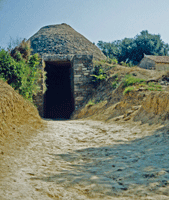
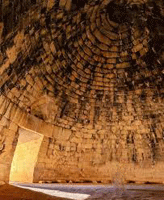
The beehive tomb, also known as a tholos tomb is a burial structure characterized by its false dome created by the superposition of successively smaller rings of mud bricks or stones. Excavation of this tomb began on 25 May 1953, directed by Lord William Taylour and undertaken by four workmen.
The interior of the tomb was dug in two sections, separated artificially by a staircase formed to allow workmen to access the interior space. The floor of the tomb was found 4.9m down from the surface, revealing a structure with a total diameter of 9.35m. Excavation continued a further 1m to investigate pits dug into the tomb floor, in addition to the excavation of a stone cist found by the south-east wall. Excavation ended on 23 July, 51 days after the first trench was opened.
The tomb was subsequently reconstructed by the Greek Archaeological Service in 1957. Sadly, there was little documentation of the reconstruction process. The most obvious part of the reconstruction was the rebuilding of the domed roof, whose original structure had been discovered in a collapsed form during the excavation.
Comparing archival photographs to the monument as can be visited today, it is also clear that repairs were made to the antas (doorjambs) of the stomion (doorway), particularly to the south anta.
We visited here in June 2004.